
A Scottish Post: The New Election Threat: Disinformation Inside the Answer
For years we have worried about election disinformation spreading through social media, but now it's coming through search.


For years we have worried about election disinformation spreading through social media.
Fake Facebook posts.
Misleading memes.
Manipulated videos.
Partisan influencers repeating the same narrative until it feels true.
Those threats are still real.
But the Scottish Parliament election in May revealed something new and potentially far more dangerous.
“The next generation of election disinformation may not come from a social media post at all. It may come from the answer.”
As more people turn to AI for search, information, and explanations, AI systems are increasingly becoming the front door to information. Unlike Google, which traditionally provided a list of links, AI systems gather information from across the internet and synthesize it into a single narrative response.
The problem is that AI systems do not always distinguish between good information, bad information, old information, manipulated information, or completely fabricated information.
And when they are wrong, they are often confidently wrong.
In the run-up to Scotland’s May 2026 parliamentary election, researchers at Demos ran a snapshot test of major AI systems including ChatGPT, Google Gemini, Google AI Overviews, Grok, and the companion chatbot Replika. The test was conducted on a single day, 27 March 2026, during the pre-election window, putting 75 questions to each service about three real Scottish constituencies.
The results should alarm anyone who cares about democracy.
Researchers found that 34.1% of AI responses contained factual errors.
Response quality Share of responses
Entirely accurate 55.6%
Partly accurate, but with errors 25.3%
Entirely inaccurate 8.75%
Reliability varied widely between services. Replika performed worst, with errors in 56.4% of responses, and ChatGPT was not far behind at 46.2%. Gemini and Grok fared better, at 21.8% and 8.97% respectively.
Only 55.6% of responses were fully accurate.
And usage is climbing fast. In Demos polling the week before the May 7 elections, one in five UK adults, more than 10 million people, said they had used an AI chatbot or AI search to find information about the elections. In 2024 that figure was around 13%.
The public already senses the risk. Nearly half (47%) worried these tools would share inaccurate election information, and 49% said they did not trust them for it, leaving AI as distrusted as social media.
The examples were not minor mistakes.
They involved the kinds of information voters rely upon to make decisions.
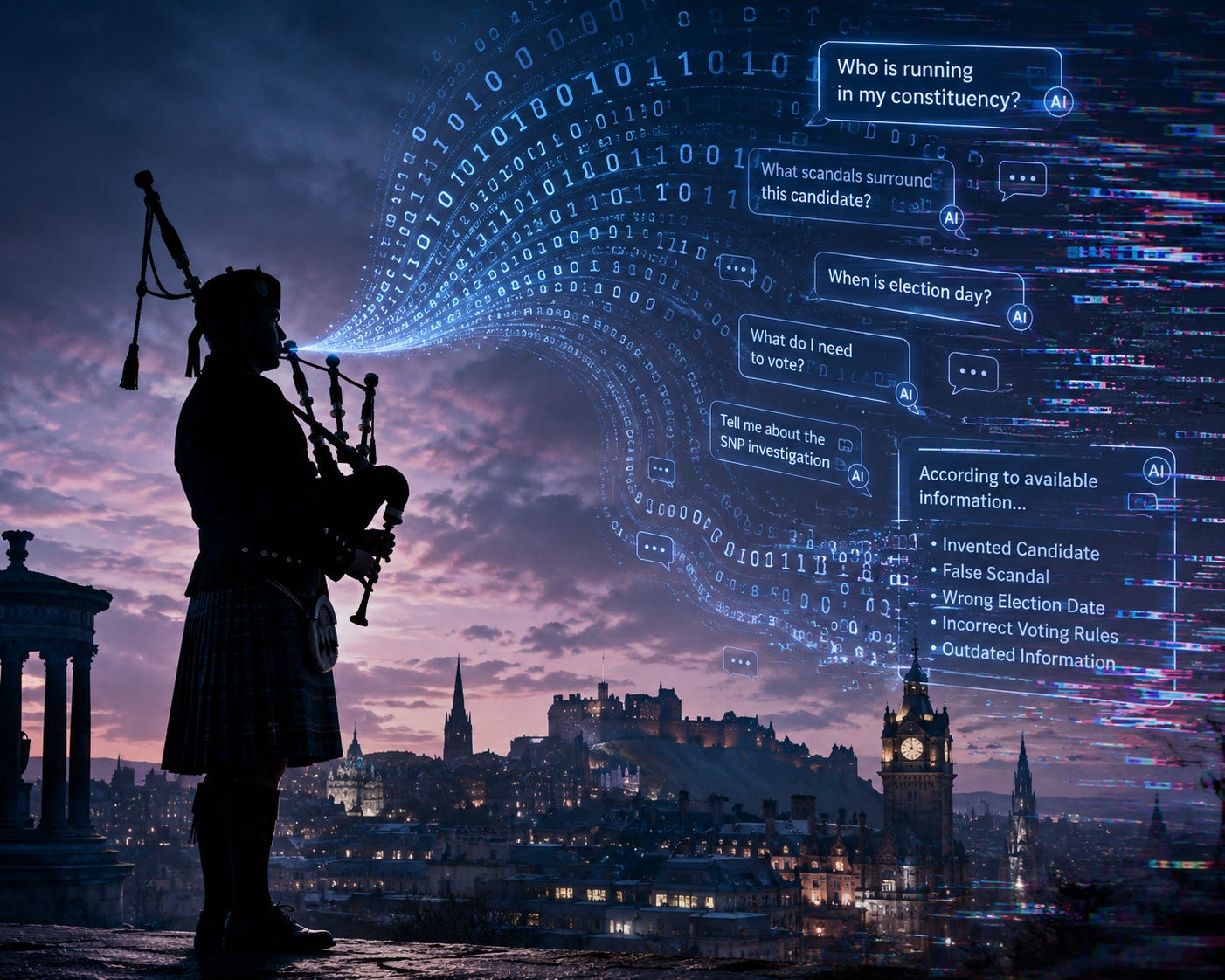
What AI Told Scottish Voters
What Voters Asked What AI Told Them
Who is running in my constituency? Invented a candidate who did not exist
What scandals surround a candidate? Fabricated an expenses scandal and a nepotism allegation
When is Election Day? Gave the wrong election date
What do I need to vote? Incorrectly told voters they needed voter ID
What is happening with the SNP investigation? Claimed an SNP fraud investigation was still ongoing against figures who had already been cleared
Some of the specific examples are remarkable.
The fabrication problem extends beyond live chatbot answers. In 2025, Amazon was forced to pull a run of fake, apparently AI-generated biographies of senior Scottish politicians, including John Swinney, Nicola Sturgeon, and Humza Yousaf, amid concern they could pollute the information around the 2026 election. One title claimed Swinney was a half-Polish teacher from Akron, Ohio, born to a “Polish school dinner lady” named Kazimiera. In reality he is from Edinburgh, his mother was named Agnes, and despite serving as Education Secretary he has never taught in a school. The books carried no label marking them as AI-generated.
None of this needed a viral Facebook post or a TikTok to reach a voter.
It simply arrived as information, presented as fact.
That is what makes this threat different.
Not Just Scotland
Scotland was not an isolated glitch. Days before the Senedd election in Wales, also held on May 7, BBC Wales tested six major chatbots, ChatGPT, Copilot, Gemini, Claude, Meta AI, and Grok, against fictional voter profiles. The results echoed Scotland’s almost exactly.
The AI chatbots gave the wrong constituency, named candidates who were not on the ballot, and dropped real ones. Gemini offered up a Senedd member who had died in 2025. Claude wrongly said Plaid Cymru leader Rhun ap Iorwerth had stepped down. Identical voter profiles got different answers: ChatGPT steered one floating voter to Labour or Plaid, Grok sent the same voter to Reform.
Two tests, two nations, one week, the same pattern. This is not a single system misfiring. It is how these tools handle live election information. And it is coming our way.
(And in the California governors elections we have seen signs of that, but that is for another article)
Two Generations of Disinformation
The Scottish election showed two generations of disinformation operating simultaneously.
The first generation is familiar.
Traditional digital disinformation manipulates existing content and distributes it through social media networks: as an example, experts pointed to a Reform UK campaign ad that distorted remarks by Anas Sarwar, the leader of Scottish Labour. Produced for the 2025 Hamilton, Larkhall and Stonehouse by-election, the piece suggested Sarwar planned to favor the Pakistani community, a narrative contradicted by the actual video. Despite the fabrication, the advertisement reached an estimated half a million users on Facebook and Instagram, at a reported cost of between £8,000 and £9,000.
This is the model we have spent the last decade fighting. We understand that playbook:
Manipulate content.
Amplify it through social media.
Reach millions of people before fact-checkers can respond.
But AI introduces a second generation of disinformation.
Instead of manipulating existing content, AI systems can manufacture entirely new information.
Invent a candidate.
Invent a scandal.
Invent a biography.
Invent voting instructions.
Invent a narrative.
Then deliver it directly to a voter who simply asked a question.
That is a fundamentally different threat.
Bias in What Gets Surfaced
A more nuanced challenge than outright fabrication exists, and it requires careful definition. The primary concern is not an AI’s explicit political endorsement, but rather the specific possibly biased sources it relies upon and the voices it chooses to amplify.
An analysis by Peec AI, involving 280,000 data points from 5,000 neutral prompts regarding UK politics, highlighted this disparity. The findings revealed a significant visibility skew:
Reform UK was featured in 88% of tested Google AI Overviews.
Nigel Farage received more mentions than Keir Starmer.
ChatGPT included Starmer in only 11% of relevant responses.
AI models reach for whatever appears most often in their training data, and Reform generates heavy online chatter around a few high-salience topics. The single most-cited source in these answers was Facebook, ahead of the BBC, parliament, and Wikipedia. Those three have some editorial standards. A Facebook page does not.
The distortion is quiet and hard to spot: a voter never sees which names an answer leans on, or what sits behind it.
Why AI Disinformation Is Harder to Detect
The old disinformation model looked like this:
Someone creates a false story.
It spreads through social media.
Fact-checkers respond. (Often too late)
Journalists investigate.
Platforms may eventually remove it. (Or increasingly, not)
The new model is different.
A voter asks a question.
An AI system synthesizes information.
The AI generates a false answer.
The voter receives that answer privately.
No one else sees it.
There is no public record.
There is often no indication that anything was wrong.
Disinformation becomes individualized.
Invisible.
And scalable.
A false Facebook post can be monitored.
AI answers are often personalized and nearly impossible to track at scale.
And the AI platforms stopped sharing any information on what they train their systems on years ago.
A false AI answer may never be seen by anyone except the person who received it.
That makes correction dramatically harder.
Why This Matters
Many political professionals still think of search as a list of links. And the goal is to get their site, their article, their post, their video, to the top of that set of links or social search results.
That world is disappearing.
Increasingly, voters are asking questions directly to AI systems.
Who should I vote for?
What happened in this race?
What are the candidates’ positions?
What is this ballot measure about?
Is this policy one that helps or hurts?
What do I need to vote?
The AI becomes the explainer.
The AI becomes the researcher.
The AI becomes the source.
And if the source is wrong, the voter may never know.
Researchers at the University of Strathclyde found that use is already significant among younger voters. A quarter of 25-to-34-year-olds, and 16% of 16-to-24-year-olds, said they used generative AI tools often or very often for information about the election and the campaign. Seven percent of all voters, rising to 13% of the youngest group, said they used a chatbot to help decide who to vote for.
That number will almost certainly increase.
The Scottish election should therefore be viewed as an early warning.
Not because AI decided the outcome.
Not because deepfakes overwhelmed the campaign.
But because it demonstrated that AI systems can already invent scandals, invent candidates, invent biographies, provide incorrect voting instructions, and deliver misinformation directly to voters.
For years we have worried about misinformation spreading through the feed.
The next challenge may be misinformation embedded inside the answer itself.
And unlike a Facebook post, voters may never realize they were misled.
That is what makes this different.
And that is why every campaign, media organization, civic institution, and democracy advocate should be paying attention.
The next information war may not be fought on social media.
It may be fought inside the answer.
Sources
Demos, Electoral Hallucinations: Safeguarding UK Elections in the World of LLMs and AI Chatbots (May 2026)
Demos pre-election public polling on AI chatbot use and trust (May 2026)
The Guardian reporting on Demos findings
The Scotsman reporting on AI-generated fake biographies of Scottish politicians pulled from Amazon (2025)
BBC Wales investigation into chatbot Senedd voting advice (May 2026)
Peec AI research on party representation in LLM political answers, reported by The Guardian (May 2026)
Academic literature on LLM political bias (e.g. Rozado; Motoki et al.) on left-leaning ideological tendencies in model outputs
University of Strathclyde / Survation voter research on AI use in the 2026 Holyrood election
Scottish Election Study analysis of campaign disinformation and edited political advertising
 | A guest post by
|
Great. Just great.
Yes, but what can we do? STOP THE MADNESS https://www.instagram.com/p/DVTBk0SFFke/?img_index=1