
The Next Information War Is Already Here
AI systems are consuming false, misleading, and manipulated content from across the internet - and increasingly presenting it as authoritative answers to millions of users.


For years, Democrats and progressive institutions have treated disinformation like a campaign problem.
Something bad happens. The right attacks. We draft a statement. We call reporters. We post a graphic. Maybe we run some ads.
That model is now badly out of date.
The modern right-wing information machine is not a campaign. It is an always-on organic digital network. It runs 24 hours a day through podcasts, Facebook groups, YouTube shows, influencers, fake local news sites, Reddit threads, newsletters, TikTok clips, and partisan websites that look just official enough to fool people.
It does not wait for election season.
It does not wait for permission.
It does not care whether the claim is true.
And increasingly, it dwarfs the reach and speed of mainstream media.
That was already a serious problem. Now there is a new threat layered on top of it: AI search.
Since 2025, more people have started going to AI first. Not Google. Not a newspaper. Not an organization’s website. They ask ChatGPT, Gemini, Perplexity, Claude, Grok, or Google’s AI summaries to explain the world to them.
That changes everything.
Google search, for all its problems, still mostly gave people a list of links. You could fight to show up. You could optimize a page. You could earn a headline. You could hope people clicked through.
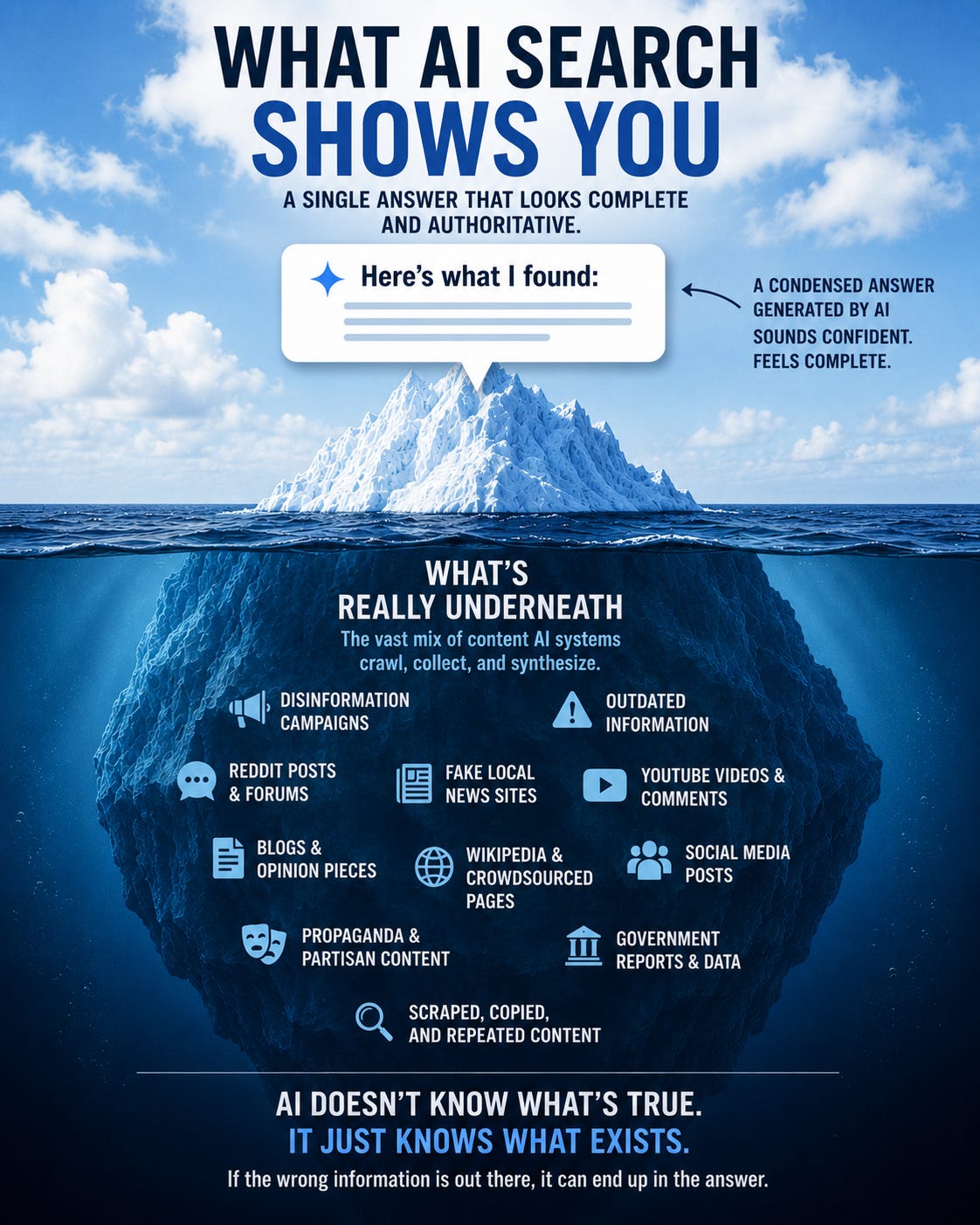
AI search does something different. It reads the internet, grabs pieces from multiple sources, and turns them into a single confident narrative answer.
That answer often feels complete.
It often sounds authoritative.
And it often arrives before the user ever clicks a link.
The platforms include disclaimers saying they can make mistakes. But the user experience says the opposite. The answer is presented as the answer. Not as a debate. Not as a source list. Not as a set of claims to verify.
And that answer is not truly fact-checked.
Yes, AI systems may give more weight to news sites, government pages, and official sources. But they also rely heavily on Wikipedia, Reddit, YouTube, LinkedIn, forums, review sites, scraped content, and whatever else is accessible, repeated, structured, and easy to ingest.
That means the new front door to information is not neutral. It is shaped by what the machine can find.
And the machine can only find what exists.
This is where progressives have a structural problem.
Many left-of-center organizations have websites that are too thin, too locked down, too PDF-heavy, too slow to update, and too campaign-season oriented. We put the good stuff in reports no one can crawl. We bury facts in PDFs. We publish only when we are launching something. We avoid repeating attacks because we were taught not to amplify them.
Meanwhile, the right produces volume.
They publish constantly. They create fake local news. They flood social platforms. They repeat the same phrases over and over. They build pages, clips, transcripts, explainers, posts, comments, and search-friendly content around every attack.
They are not just persuading people.
They are feeding the machine.
In one recent project Will and Tim are working on the latest attack lines from opposition research are getting directly into the LLM answers within HOURS of being posted on social, and right wing think tank local websites being sited 4 times more than local news when LLM’s were asked about a recent attack on a candidate.
That is the counterintuitive part: in the AI search era, never repeating the attack is no longer enough. If people are asking AI systems whether “teachers are indoctrinating kids” or whether “unions protect bad teachers,” and our side has no clear, crawlable, searchable answer using that language, then the AI answer will be built from the content that does exist.
And we already know the systems fail.
Before Scotland’s 2026 election, Demos found that AI chatbots gave voters misinformation in roughly a third of tested election questions, including fake scandals, invented candidates, and wrong election dates. That was not a theoretical problem. It was a live election environment.
“Disinformation actors are, by definition, early adopters — they will use every technique and every technology they can… “
Mr. Chambers said that his clients were thinking about “needing to rebuild their websites for machines as much as for humans,” and considering how to show up in chatbot queries posed in multiple languages.
The New York Times - “Politicians are Trying to Change What AI Says About Them”
We are also seeing the growth of AI slop, fake campaign content, cloned news sites, malicious election domains, and pink-slime local news operations. NewsGuard found that fake local news sites now outnumber real daily newspaper sites in the United States.
This is the next phase of disinformation.
Not just lies that spread on Facebook.
Not just attack ads.
Not just deepfakes.
But rather outdated, or false or distorted narratives getting absorbed into the information layer that AI systems use to explain reality.
So what do organizations need to do?
First, they need to stop treating websites as brochures. Websites now have to be knowledge bases. They need clear explainers, FAQs, issue pages, myth-vs-fact pages, transcripts, structured data, schema markup, author bios, source citations, and regularly updated HTML content that AI systems can crawl and understand.
Second, they need to stop hiding their best arguments in PDFs. PDF’s can be read by AI systems, but not nearly as cleanly or efficiently as other formats.
PDFs are still useful for donors, boards, and policy audiences. But if the goal is discoverability, the content needs to live in searchable pages, articles, posts, captions, transcripts, newsletters, and public resource hubs.
Third, they need to build content around the actual questions people ask. Not just “our position on public education,” but “are teachers indoctrinating students?” Not just “school funding policy,” but “do vouchers hurt rural schools?” Not just “union rights,” but “do unions protect bad workers?” We have to answer the attack language directly, without adopting the attack frame.
Those need to be in public FAQ pages, and websites need to give clear technical guides under the hood for AI systems to find those.
Fourth, groups need to publish more often. AI flags press releases and news services. One press release a month will not compete with an always-on ecosystem. The right is not waiting for your communications calendar. It is defining the issue every day.
In work Tim and Will have done together we find LLM’s woefully slow in some cases at updating new, current and accurate data fast changing campaigns. Your website should help them get the latest facts at campaign level speed.
Fifth, organizations need authentic organic communication, not just polished campaign content. Teachers explaining what happens in classrooms. Nurses explaining what staffing cuts mean. Union members explaining what due process actually protects. Parents explaining why public schools matter. Local voices. Real stories. Repetition. Distribution.
This is not just SEO anymore.
It is not just social media.
It is not just rapid response.
It is information infrastructure.
The scale of the problem is enormous. Mainstream media is shrinking. Local news is collapsing. Fake local news is growing. Right-wing organic media is always on. AI search is becoming a primary way people understand issues. And the systems generating these answers are pulling from an internet that bad actors are already trying to manipulate.
The worst mistake progressives can make is to treat this as a future problem.
It is not coming.
It is here.
If we do not build the content, someone else will.
If we do not answer the attacks, the attacks will answer themselves.
If we do not show up in the new information ecosystem, AI systems will still tell people a story about us.
It just will not be our story.
Source notes:
[6] New York Times: Politicians Are Trying to Change What Chatbots Say About Them (Quotes From Tim)
 | A guest post by
|
Excellent post however frightening it is. What strikes me is that many people of the younger generations do not engage in critical thinking so would never even question the AI summary at the top of search - or even know how to quickly check if what they are seeing is accurate.
Great article. Could not agree more - I wrote about this same issue only a few weeks back
https://elliotduff.substack.com/p/the-data-war-we-are-losing.
This war is real but unfortunately many are not paying attention.
Websites now have to be knowledge bases - not just repositories of PDF's.
I wrote this in response to the failure of Science to be Salient in Australia.
https://elliotduff.substack.com/p/the-salience-series
But as you point out this goes beyond that - into the political arena.