


Tim’s new study scanned every campaign website in the 2026 battleground. Both parties are equally unprepared for the AI systems now answering voters’ questions - and this is the rare problem you can fix in an afternoon.
A voter in a tossup district types a candidate’s name into ChatGPT and asks who this person is.
The AI chatbot or Google AI search answers, in a few seconds, out of whatever sources it can reach right then. The campaign has no idea the question was asked, no idea what came back, and has done nothing to make sure the answer is right.
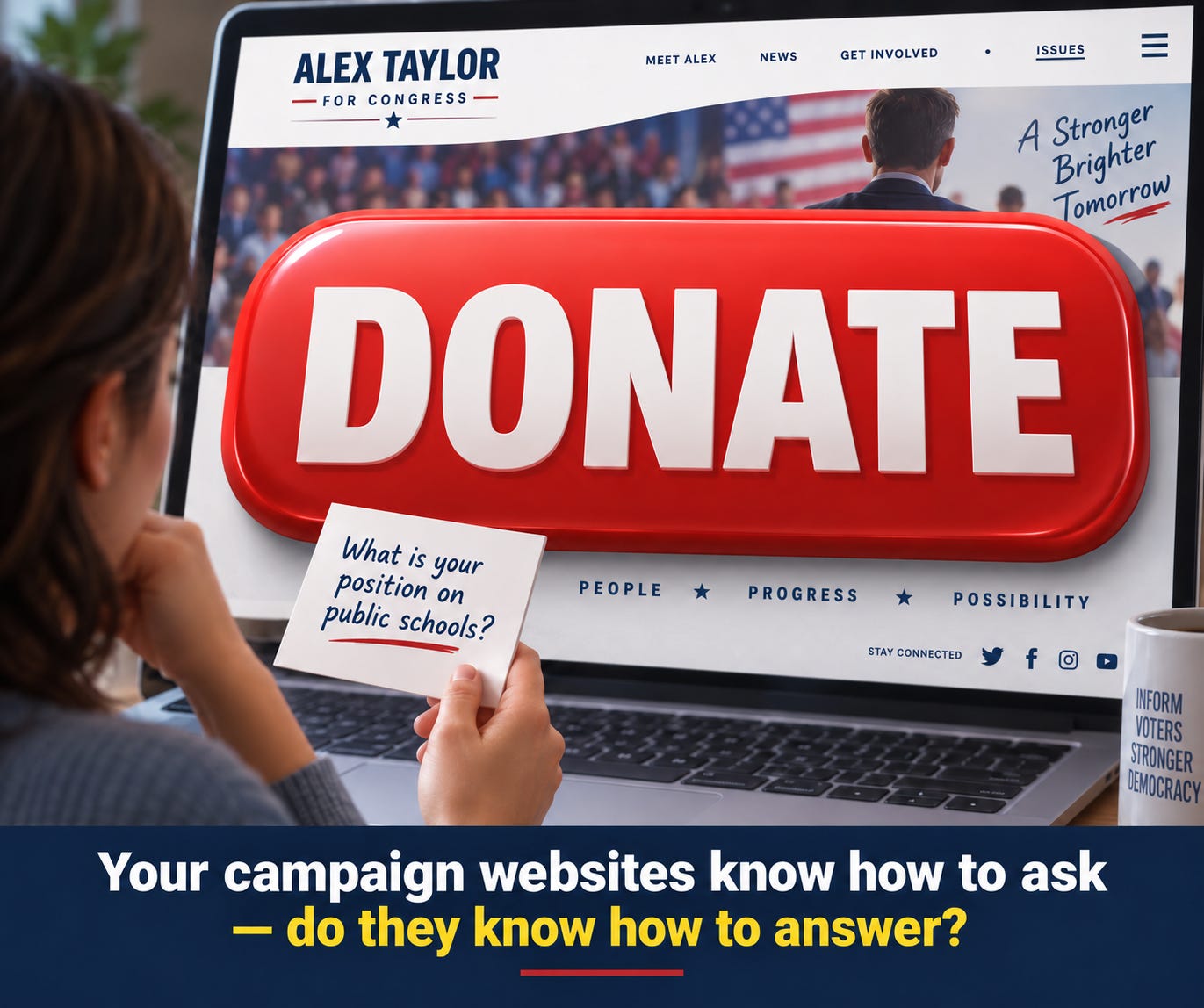
Tim and his team just scanned every competitive campaign website on both side this midterm for Innovating for the Public Good: 126 candidate sites across the 63 races rated Toss-up or Lean by The Cook Political Report or Sabato’s Crystal Ball.
The finding surprised us both.
For once, both sides are failing identically
Not sure that counts as “good news.” In February, Tim ran this same audit on news and political publishers and found a real partisan split running the wrong way: high-fact, center-left outlets blocking AI crawlers at roughly ten times the rate of right-leaning sites, while hyperpartisan outlets left the door wide open.
Campaign websites are a different story. There is no split. There is no strategy at all.
On the one hand:
Candidate websites score 0.963 on a 0-to-1 scale of openness to AI crawlers - more open than any publisher category in February, including the hyperpartisan tier at 0.784. Of the 114 sites with a readable configuration, 103 block nothing at all.
On the other hand, no one is trying either way:
Democratic sites score 23.1 on how deliberately they govern AI access. Republican sites score 22.3.
And nearly every apparent exception is a switch somebody’s web host had flipped to a setting no one changed.
Only six sites register as actively governing their AI access; but when we looked deeper all six carry the same Cloudflare default.
One campaign in the entire battleground wrote its own rules, and that file contradicts itself.
No one is trying.
But what’s more troubling is they are all equally not ready for AI agents. Which really matters. At this stage of the game, it may matter more than being open to AI training does.
The distinction almost everyone is missing
AI companies run two different kinds of bots, or AI crawlers that pull data from your website.
One collects pages to train the models. That is how a system comes to know your candidate exists. It is months out of date by the time a voter sees an answer, and you cannot change it now.
The other fetches pages to answer a question somebody just asked. It visits constantly and sometimes opens your page while the answer is being written. What it finds on your site today is what the voter reads today.
Blocking the first keeps you out of the training data. Blocking the second keeps you out of the answers.
Almost nobody out and out blocks the second. Only two of the 126 do, and one looks accidental.
So access is not the problem. The problem is what the answer bots find when they arrive, which is a website built entirely for human visitors.
Only 28 of 126 sites across both sides publish an llms.txt, the short file telling an AI agent how a site is laid out. Five publish an agents.md. Zero publish a machine-readable interface. And most of the 28 did not choose it. It shipped with the hosting package.
Why it is worth your last four weeks
Across a sample of 124,949 citations from AI answers about these races, official campaign websites are about 6 percent of everything cited - fifth of sixteen source categories, ahead of all social media combined (3.7 percent) and all partisan media combined (2.5 percent).
Campaign sites are not the biggest source. Wikipedia and Ballotpedia together are close to a quarter. Regional and local news is second at 17.5 percent. But the campaign website is the largest source a campaign owns outright. Everything above it belongs to somebody else.
Then the number that matters is the error rate. Tim’s team asked seven AI engines the same question about each of the 126 candidates and graded more than 1,600 answers against a sourced fact sheet
So, this is not just about whether an AI answer gets the candidate’s hometown right. It is about having a clear, documented public record ready when the attacks come. Publish the actual position. Explain the vote. Link to the original document. Do not wait until a false allegation is circulating to discover that your own website has nothing useful to say about it. We cannot control every answer an AI system produces. We can take responsibility for the evidence we make available. Chasing the last lie cannot be our only strategy.
Start with what we control. Then change how we communicate.
Disinformation spread through AI search is a serious problem - but we are not powerless to respond. We can start with what we control: making our websites not just open to AI search, but easier for those systems to read and use. That alone will not solve the problem. We also need new strategies for getting accurate information to people wherever they turn for answers. When the rules change, the strategy must change. We’ll be writing more about those strategies - and the practical steps we can take to put them to work.
The Full Dewey Square Group Report for Innovating for the Public Good
From A(AI) to Z (zetitics) , too many modern campaigns obsess over flashy TV while neglecting the power of AI, the need to look into the mirror and admit bad decisions, and the power of human connection. Screen ads and many social feeds miss the point entirely, downplaying the unmatched value of cheap, multiple contacts—knocking doors, handing out leaflets, holding coffees and town halls. If we rely solely on high-tech shortcuts, we lose the personal touch. To truly win people over, we need grassroots zeal right where voters live. If we ignore AI, we lose elections.
Thanks, Tim. Swing Blue Alliance is seeing the same thing − and how it can disadvantage Democratic challengers without a voting record to hang their hats on. https://grassrootsconnector.substack.com/p/how-ai-candidate-comparisons-hurt